Introduction
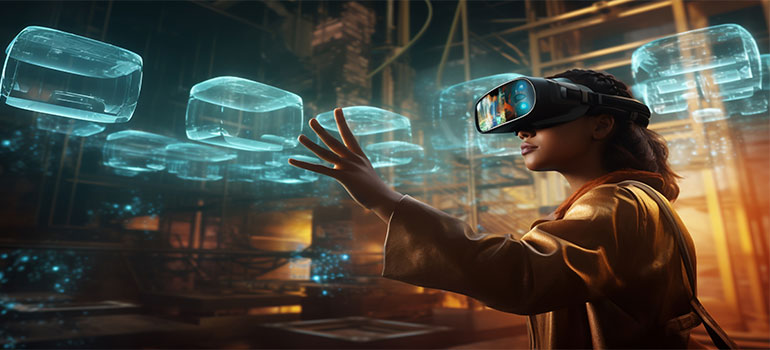
AI and spatial computing in hologram technology are redefining how digital content appears and behaves in real environments. Instead of static projections, modern holographic systems use intelligent processing and spatial awareness to deliver interactive 3D visuals. As immersive demand increases, businesses integrate smarter hologram platforms to enhance engagement.
Today, industries rely on AI-driven spatial engines to power next-generation holographic solutions.
Why AI and Spatial Computing Matter in Holographic Systems
First, artificial intelligence enables real-time object recognition and adaptive rendering. This allows holograms to respond dynamically to user interaction.
Second, spatial computing maps physical environments with precision. As a result, holographic projections align accurately with real-world surfaces.
In addition, AI enhances gesture detection and voice interaction. Therefore, hologram systems become more intuitive and responsive.
Because of these advancements, AI and spatial computing in hologram technology create highly immersive digital ecosystems.
Core Technologies Powering Intelligent Holograms
Several advanced solutions support modern holographic platforms.
- AI-Based Computer Vision
Companies like NVIDIA provide GPU acceleration for real-time AI rendering and deep learning processing.
- Spatial Mapping and Mixed Reality Devices
Hardware such as Microsoft HoloLens 2 integrates depth sensors and environment mapping for spatial hologram placement.
- Edge and Cloud Computing
Distributed processing allows holographic content to update instantly without latency issues.
Together, these technologies enable accurate, intelligent, and scalable holographic systems.
Applications Across Industries
AI and spatial computing in hologram technology support diverse sectors.
Healthcare
Medical teams visualize 3D anatomy models during surgical planning.
Education
Students interact with immersive holographic simulations.
Retail and Experience Centers
Brands showcase products using interactive hologram displays.
Enterprise Collaboration
Remote teams meet in shared holographic environments.
Consequently, organizations improve communication, visualization, and decision-making.
Benefits of AI-Powered Hologram Technology
Moreover, businesses gain measurable advantages:
- Real-time interactive visualization
- Improved spatial accuracy
- Enhanced user engagement
- Scalable immersive deployment
Because holographic systems combine intelligence with spatial awareness, they deliver more realistic experiences.
Challenges in Implementing AI-Driven Holograms
However, implementation involves certain challenges.
- High hardware costs
- Processing power requirements
- Complex software integration
- Environmental lighting limitations
Even so, rapid innovation continues to reduce technical barriers.
The Future of AI and Spatial Computing in Hologram Technology
Looking ahead, AI and spatial computing in hologram technology will integrate predictive analytics, advanced neural rendering, and lightweight wearable devices. As immersive ecosystems expand, holographic systems will become central to enterprise strategy.
Therefore, organizations investing early in intelligent holographic platforms will lead the next wave of digital transformation.
Conclusion
AI and spatial computing are the driving forces behind the evolution of hologram technology. By combining intelligence with spatial awareness, holograms are transforming how people interact with digital content, enabling immersive experiences that bridge the gap between the physical and digital worlds.