
Gesture Technologies Powering Next-Generation XR Applications
Introduction
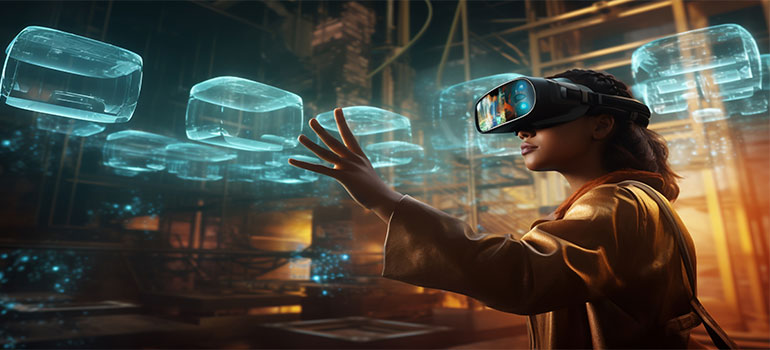
Gesture technologies in XR applications are redefining how users interact with immersive environments. Instead of relying on controllers or touchscreens, individuals can use natural hand and body movements to navigate digital spaces. As XR adoption grows, intuitive interaction becomes essential for user engagement.
Today, industries integrate gesture-based systems to create more immersive and responsive experiences.
Why Gesture Technologies Matter in XR
First, gesture interaction improves usability. Users can manipulate 3D objects with simple hand movements.
Second, these technologies enhance realism. When movement mirrors real-world behavior, immersion increases significantly.
In addition, gesture recognition reduces dependency on physical controllers. Therefore, XR systems become more seamless and user-friendly.
Because of these advantages, gesture technologies in XR applications are rapidly expanding across industries.
Core Technologies Behind Gesture-Based XR Systems
Several advanced solutions power modern gesture interaction.
- Optical Hand Tracking
Devices like Meta Quest 3 support controller-free hand tracking using onboard cameras and AI processing.
- Depth-Sensing and Motion Capture
Systems developed by Ultraleap enable precise finger tracking for enterprise XR applications.
- AI-Powered Gesture Recognition
Machine learning models analyze motion patterns and convert them into digital commands in real time.
Together, these technologies enable accurate and responsive immersive interaction.
Applications of Gesture Technologies in XR Applications
Gesture technologies in XR applications support diverse use cases.
Healthcare Training
Surgeons can practice procedures using gesture-controlled simulations.
Industrial Design
Engineers manipulate 3D prototypes in virtual environments.
Education
Students interact with immersive learning modules naturally.
Retail and Experience Centers
Customers explore products in virtual showrooms using intuitive gestures.
Consequently, XR systems become more engaging and practical for real-world deployment.
Benefits of Gesture-Based XR Interaction
Moreover, businesses gain measurable improvements:
- Increased user engagement
- Higher interaction accuracy
- Reduced hardware dependency
- Improved accessibility
Because gesture systems feel natural, users adapt quickly without extensive training.
Challenges in Implementing Gesture Technologies
However, certain challenges remain.
- Environmental lighting sensitivity
- Gesture misinterpretation risks
- Hardware cost considerations
- Integration complexity
Even so, ongoing innovation continues to improve precision and scalability.
The Future of Gesture Technologies in XR Applications
Looking ahead, gesture technologies in XR applications will integrate AI personalization and haptic feedback systems. As immersive computing evolves, natural interaction will become the default interface model.
Therefore, organizations investing in gesture-enabled XR systems today will lead the next wave of digital transformation.
Conclusion
Gesture technologies are a foundational component of next-generation XR applications. By enabling natural, touchless interaction and deeper immersion, they are transforming how users experience and interact with AR, VR, and MR environments.