

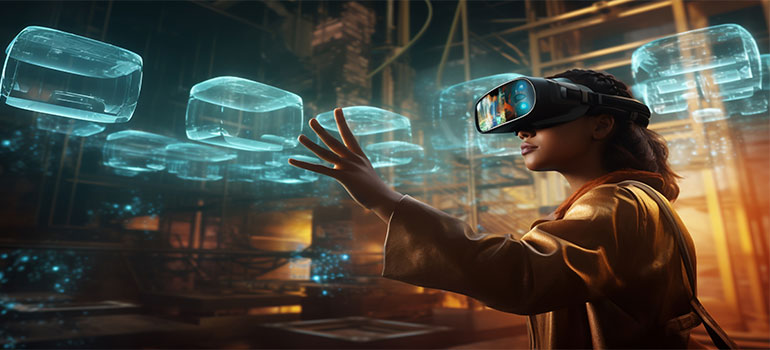
Spatial Computing and the Rise of Immersive Experiences
Introduction
Spatial computing in immersive experiences is changing the way people interact with digital environments. It allows computers to understand physical space and combine it with digital content.
Today, technologies like augmented reality and virtual reality use spatial computing to create interactive environments. As a result, users can move, explore, and interact with digital objects in a natural way.
Because of this innovation, immersive technologies are becoming more powerful and useful.
What Is Spatial Computing?
Spatial computing refers to technology that understands the physical environment. It uses sensors, cameras, and advanced software to map real-world spaces.
For example, a spatial system can detect surfaces, objects, and movement. Then it places digital content within that space.
Therefore, users can interact with digital elements as if they were real.
Spatial Computing in Immersive Experiences
Spatial computing in immersive experiences helps create more realistic digital environments. It allows systems to track movement and respond to user actions.
For instance, users can walk around virtual objects, move them, or interact with them naturally. In addition, spatial mapping improves the accuracy of augmented reality applications.
Because of these capabilities, immersive experiences become more engaging and interactive.
Companies such as SelectronWave Technologies explore immersive technologies that rely on spatial computing to create advanced digital solutions.
Applications Across Industries
Education and Training
Spatial computing helps students explore 3D learning environments. For example, learners can study complex structures through interactive models.
Healthcare and Medical Visualization
Doctors use immersive tools to visualize medical data in 3D space. As a result, they can better understand complex medical information.
Product Design and Engineering
Design teams use spatial computing to view and test digital prototypes. Therefore, they can improve designs before production begins.
Entertainment and Gaming
Gaming platforms use spatial computing to create immersive virtual worlds. Consequently, players experience more realistic and interactive gameplay.
Benefits of Spatial Computing
Spatial computing offers several advantages for immersive systems.
First, it improves user interaction with digital environments. Second, it allows natural movement and spatial awareness.
In addition, it helps organizations visualize complex information more clearly. Because of this, many industries are adopting immersive solutions.
Future of Spatial Computing
The future of spatial computing in immersive experiences looks very promising. New hardware and software innovations will make these systems more powerful.
In the coming years, spatial computing will support advanced XR applications, smart environments, and interactive digital platforms.
Therefore, it will play an important role in the future of immersive technology.
Conclusion
Spatial computing is a key technology behind modern immersive experiences. It helps digital systems understand physical space and user movement.
As immersive technologies continue to evolve, spatial computing will enable more realistic and engaging digital environments across many industries.